The Bit That Grew Legs: How UK Troupes Are Turning Sketch Favourites into Short Films
Photo: kallerna, CC BY-SA 4.0, via Wikimedia Commons
Every comedy troupe has one: the character who does the heavy lifting. The minor royal with no filter, the middle manager who says 'let's circle back' like a man defusing a bomb, the local newsreader who cannot pronounce a single place name correctly. For years these creations have lived and died on the sketch reel — two minutes of setup, a swerve, a blackout, a pint.
In 2026, though, a growing number of British teams are doing something riskier: taking that reliable laugh machine and asking it to carry eight to twelve minutes of actual story. Not a supersized sketch. A short film. The difference, as anyone who has attempted the jump will tell you, is roughly the difference between doing a card trick and staging a magic show.
The two-minute rule and the eleven-minute problem
A sketch character is built to repeat. The whole pleasure is recognition — you know this person, you know their delusion, and you are waiting for the delusion to be punctured. A short film needs something a sketch never does: change. Or at least the credible threat of it.
'You can get away with a character who just is for 90 seconds,' says one Leeds-based writer-performer whose troupe has spent the past year turning an aggressively cheerful funeral director into a ten-minute short. 'The moment you ask for ten minutes, the audience starts wanting to know what he wants. And if the answer is nothing, he's just odd, they drift.'
That drift is the graveyard of the genre. Teams describe a common failure mode: the character who is hilarious in thirty-second bursts becomes, at minute six, a person the audience has politely stopped listening to. The gag hasn't died. It has simply run out of road.
Testing a character without a punchline to hide behind
The practical solution, according to several teams currently doing this, is to test in public before committing. Not with a finished script — with a question. Can this person survive a conversation in which nobody says anything funny?
Some companies now run 'spine nights' at small venues and comedy clubs where a recurring character is dropped into an unscripted interview or a live Q&A, with no sketches around them. If the room stays with the character through ninety seconds of mundane dialogue, that's a green light. If the audience starts looking at the bar, it's back to the group chat.
Others test online, cutting micro-episodes of forty to sixty seconds that function less as sketches and more as character studies. The comments do the rest. It is, in effect, free market research with worse lighting.
What actually changes when the sketch grows up
Three things tend to shift. First, the supporting cast stops being props. In a sketch, other performers exist to feed the punchline. In a short, they need their own wants, even if those wants are small and pathetic. Many teams report that the hardest rewrite is giving the straight man a life.
Second, silence returns. Sketch comedy is terrified of dead air; short film lives on it. The best of the new hybrids use pauses, wide shots and the terrible slow realisation that a character has said the wrong thing to the wrong person with the wrong amount of confidence.
Third — and this is the one nobody warns you about — the reset button disappears. A sketch can end and start fresh. A short has to end with consequences, even tiny ones. One troupe's rule: the final shot must be impossible to cut back to the first. If it is, you've written a sketch with extra steps.
Where the hybrid finds its people
The good news is that there are now more places for an eight-to-twelve-minute character piece to land than at any point in the past decade. The festival circuit — London Short Film Festival, Encounters in Bristol, Aesthetica in York, Glasgow Short Film Festival, Norwich — has warmed considerably to comedy that arrives with a recognisable face. Programme teams quietly admit that a film with an established online following helps sell a late-night slot.
Broadcast and streaming comedy strands remain interested, particularly when a short can double as a pilot. And online, the arithmetic has changed: a well-cut ten-minute short with a strong thumbnail can outperform six sketches stitched together, because it gives the algorithm a single thing to sell.
The greenlight that lives in a group chat
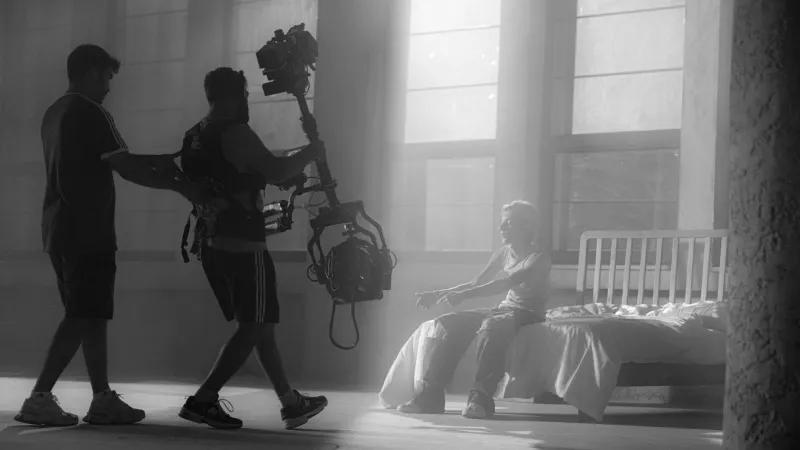
What all of this looks like in practice is less glamorous than the word 'greenlight' implies. It is a WhatsApp thread with a pinned message, a shared spreadsheet, and one person who owns the camera. Budgets are frequently three figures plus favours. Locations are a nan's bungalow, a working men's club, a retail park at dusk.
But the ambition has shifted. Teams are no longer asking whether a recurring character deserves a short film. They are asking which one can survive one. That is a healthier question, and it is producing better films — the funny ones that also, unexpectedly, have a third act.
The bit, it turns out, has legs. Whether it can walk is another matter.