No Second Chances: The Unbroken-Take Sketch and the Art of Getting It Right in Front of Everyone
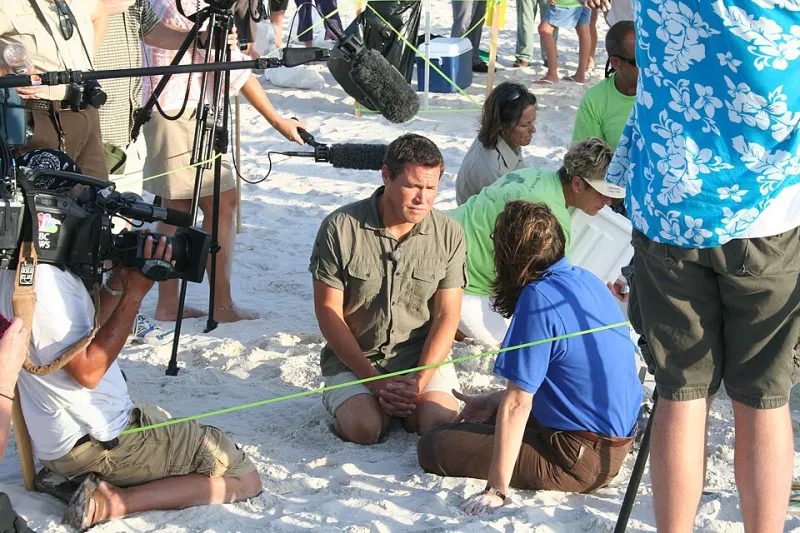
Photo: Maxfield Barbara, U.S. Fish and Wildlife Service, Public domain, via Wikimedia Commons
There is a particular silence on a film set just before a one-take. It is not artistic silence. It is the silence of six people realising that nobody has a plan B, the camera battery is at 43 per cent, and the actor playing the landlord has just said the phrase 'I think I know my lines' with the confidence of a man who definitely does not.
And yet the unbroken take remains one of the best bargains in British sketch filmmaking. No coverage. No reverse angles. No cutting around a fluffed line in the edit. Just one camera, one path, and a group of performers who have to be exactly where they said they would be, exactly when they said they would be there.
UK audiences have been trained for this. The Office made us connoisseurs of the long, excruciating hold. Boiling Point turned a single-take kitchen into a stress dream with a wine list. Even the humble pub sketch works better when the camera refuses to blink. A long take does not just look cinematic on a shoestring; it feels like theatre with a memory card.
The budget argument: your edit suite is a spreadsheet of regret
Coverage is expensive in ways that do not always show up on the invoice. Every extra angle means another lighting reset, another sound check, another twenty minutes of actors standing in a corridor holding a prop bag while someone looks for a screwdriver. A one-take sketch strips that out. You light one room. You rehearse one route. You shoot it until it is right, or until the light leaves the building and the neighbours start using the word 'council' in a tone that suggests a phone call.
The money you save on setups goes into rehearsal. That is the trade. You are not buying a crane; you are buying Tuesday evening in a church hall with masking tape on the floor. It is less glamorous than a lens, and considerably more useful.
Rehearsal is the edit
In a conventional sketch, the edit fixes rhythm. In a one-take, the rehearsal does. You need a beat map: where the laugh sits, where the turn happens, where the actor crosses from the sofa to the window without clipping the lamp.
Block it like a tiny play. Walk the route until the furniture stops being a surprise. Give every performer a physical anchor — a mark, a prop, a particular floorboard — so that when the nerves hit, the body still knows the geography. The director's job is to remove the question 'where am I?' so that the actor can concentrate on 'what am I doing?'.
And rehearse the boring bits. The door handle that sticks. The cup that has to be picked up on a specific line. The moment someone has to sit down without making the chair announce itself like a brass band. Comedy is timing, but the unbroken take is choreography, and choreography is just admin with better posture.
The geography of a lie: doorways, stairwells and badly timed kettles
If you are shooting a true one-take, you are not hiding cuts; you are hiding the effort. A doorway can swallow the camera as it moves from hallway to kitchen. A stairwell can give you a vertical reset without anyone seeing the operator's face. A passing extra with a laundry basket can cover a wobble in the pan. These are not cheats. They are staging.
The kettle is your friend. Not because it boils anything useful, but because it makes noise. A loudly timed kettle can mask the sound of a camera slider being repositioned, a floorboard creaking, or a whispered 'keep going' from a producer who has aged four years in ninety seconds. Just make sure the kettle is motivated by the scene. A kettle that boils for no reason is not a sound cover; it is a cry for help.
Sound is the ungrateful co-star
One-take sketches live or die on sound. You cannot cut to a close-up to rescue a muffled line, and you cannot rely on ADR unless you enjoy watching actors try to recreate a spontaneous laugh in a converted garage six weeks later.
Use radio mics, but check them twice. Boom where you can, but remember the boom operator is now a moving part in a single camera move — a lovely person with a pole and no interest in being in the reflection of the kitchen window. Do a full technical run with sound before you do a full performance run. Then do another one, because someone will have switched a mic off to charge their phone.
Performance: the gift of no net
Here is the strange alchemy: the constraint makes actors better. When there is no coverage, there is no 'we will fix it in the edit'. There is only the scene, happening now, in front of a camera that is not going to look away politely. Performers listen harder. Timing sharpens. The comedy stops being a series of lines and becomes a series of reactions.
It also makes a sketch feel live. That is not a small thing in 2026, when audiences can smell a manufactured bit of content from three scrolls away. A one-take has the texture of something that could go wrong. That risk is oddly watchable. It is the same reason we watch people on stage rather than a recording of people on stage: the possibility of disaster is part of the ticket.
The emergency plan you will pretend not to need
You should still have a plan. Shoot a safety version where a doorway or a whip pan can hide a cut. Keep two memory cards and more battery than you think. Do a final focus check before every take, not because you are pessimistic, but because the camera operator has been staring at the same chair for two hours and has started to see through time.
And give yourself permission to do one more take. The beauty of the one-take is that it is cheap to try again. It is only expensive to be precious about it.
So put the kettle on. Tape the floor. Rehearse the walk. Then roll, and hope the landlord remembers his lines. If he does not, you can always make another sketch about a landlord who does not remember his lines. That is the British film industry, and it is beautiful.