Borrowed Dads and Charity-Shop Cardigans: Ageing Up a Sketch Without a Makeup Van
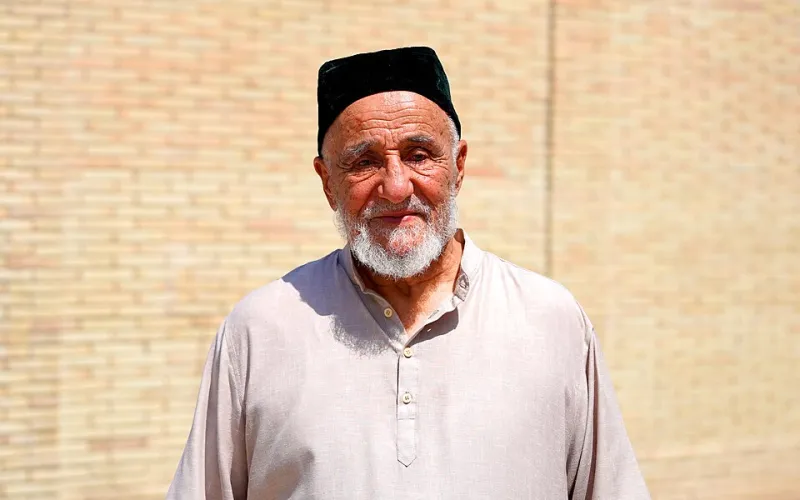
Photo: Jamshid Nurkulov, CC BY-SA 4.0, via Wikimedia Commons
Every sketch starts with a beautiful lie. A café becomes a boardroom. A corridor becomes a spaceship. And a bloke who once played Widow Twankey in 1998 becomes a retired headmaster with a troubled past. The first two are staging problems. The third is where friendships go to die.
Sooner or later, your script will ask for someone old. Not old-ish. Not 'has a sensible coat'. Properly old — the kind of person who says 'right then' before standing up. And your budget will not stretch to a prosthetics team, a wig that doesn't look like a dead hedgehog, or a hotel for a jobbing actor from Leeds. What you have is your mate's dad, a charity shop on the high street, and a vague memory of a YouTube tutorial about grey spray.
Deep breath. This is doable. It just needs a bit of discipline and a lot of cardigans.
Cast the Face You've Already Got
The single biggest mistake in low-budget ageing is trying to turn a young actor into an old one. Unless you have a proper makeup artist and three hours to spare, the result sits somewhere between 'haunted' and 'badly preserved'. Skin doesn't wrinkle on command, necks don't sag to order, and no amount of talc will convince an audience that a 26-year-old has been paying into a pension since 1979.
The clever move is to stop ageing people up and start casting people who are already there. Your mate's dad. The neighbour who lends you his ladder. The bloke at the allotment who has opinions about marrows. They bring something a trained actor often can't fake in a two-minute sketch: the way they sit, the way they hold a mug, the way they pause before answering a question as if they're consulting a small internal committee.
They also come with a built-in audience. Geoff's appearance at the local screening will pull in Geoff's entire bowling club. That's not a compromise. That's distribution.
The Grey Spray Is Not a Personality
Let's address the elephant in the room: the can of grey colour spray you bought from a fancy-dress shop for £6.99. Put it down. Step away from the can.
Grey spray has its place, and that place is the bin. Used badly — which is to say, used at all — it produces three unmistakable effects: a helmet of uniform silver, unnatural grey eyebrows that look drawn on with a marker, and a fine dusting of product over every surface in the room. It doesn't say 'distinguished'. It says 'I have been lightly floured'.
If you must add grey, do it at the temples and the sideburns only, with a stipple sponge and a matte powder. Real ageing is patchy. It collects in some places and vanishes in others. It doesn't arrive like a weather front.
And please: no wobbly voice. No hunched shuffle. No 'eh?' after every line. The moment your actor starts performing oldness, the sketch has stopped being a sketch and become a variety turn. The audience should be laughing at the line, not at the disguise sitting underneath it.
The Cardigan Is the Character
The wardrobe department for this particular production is a charity shop on a Saturday morning, and it is more powerful than any wig. A slightly oversized lambswool cardigan. A zip-up fleece in a colour that has no name. Sensible shoes that have clearly walked to a garden centre. Glasses — actual prescription ones if you can borrow a pair, because fake glasses sit on the face like a rumour.
The trick is not to dress your older character as an 'old person'. It's to dress them as a specific human being. Older people wear jeans. Older people wear nice trainers. Older people wear band T-shirts under a jacket. What makes a costume read as age is the accumulation of small, unglamorous choices: the watch with the stretched metal strap, the tissues up the sleeve, the reading glasses hanging from a cord, the biro in the trouser pocket.
Fit matters more than fuss. A jacket that's a size too big reads as a lifetime of not quite replacing things. A cardigan done up to the wrong button reads as someone who has been up since six. Both are funnier and more truthful than a stick-on moustache.
Directing People Who Have Never Been Directed
Non-actors don't want to be told to 'act'. They want to be told what to do with their hands.
Instead of 'you're old and tired', try: 'You've been on your feet since half seven, you haven't had your tea, and this young person has just asked you for a favour.' That's a situation, not a performance note. Nine times out of ten, your borrowed dad will immediately slouch, sigh, and look at the kettle. Which is exactly what you wanted.
Give them a task. Making tea. Finding a receipt. Looking for their glasses while wearing their glasses. A small, real action gives the camera something to watch and gives the performer somewhere to put their nerves.
Keep the blocking simple and let them move where they'd naturally move. Don't over-rehearse — the third or fourth take is usually where the weird, lovely, unrepeatable thing happens. And don't ask them to say anything cruel, embarrassing, or legally inadvisable. They're doing you a favour. They should leave the set feeling like a legend, not like a punchline.
Let the Camera Tell the Lie
You don't need to fix everything in makeup. You need to control what the audience can see.
Keep the frame tight. A close-up of a face that's genuinely lived in beats a wide shot of a young person in a wig every time. Use soft, diffused light — a bounced lamp and a bit of muslin will flatter anyone — and avoid hard side-lighting, which carves out every line and, on a young face, makes the disguise look even more like a disguise.
Sound does a lot of heavy lifting too. Record clean dialogue, keep the room quiet, and resist the urge to slow everything down. Older people don't speak in slow motion. They just don't fill every silence. Let the pauses sit.
The Final Rule: Nobody Should See the Seams
If your audience is laughing at the grey spray, you've lost. If they're laughing at the line about the garden centre, you've won. The whole art of ageing up a sketch on no money is making the audience forget there was ever a question of age at all — because the person on screen feels real, the cardigan feels lived-in, and the tea feels genuinely needed.
Feed your borrowed dad. Pay his bus fare. Send him the finished cut before anyone else. And for goodness' sake, let him keep the cardigan.