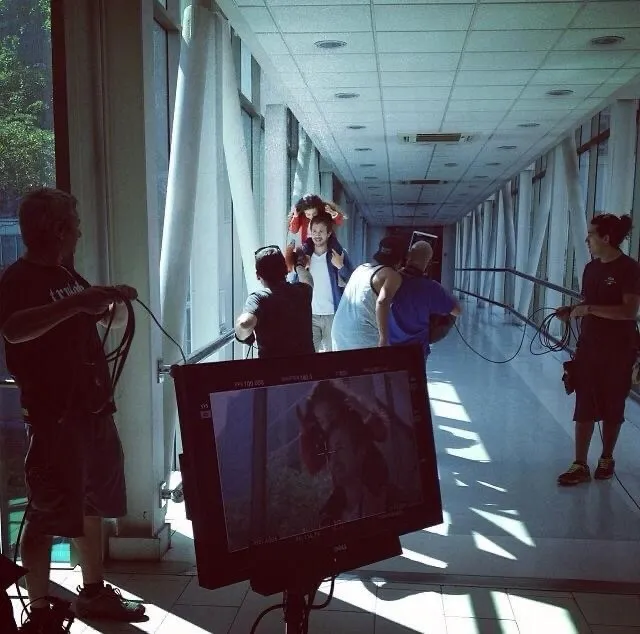
The Pub Room Is Not Your Friend: Test-Screening a Sketch With People Who Owe You Nothing
Photo: Marjory Collins, Public domain, via Wikimedia Commons
There is a particular sound a room makes when your friends watch your sketch. It is a warm, loyal, slightly pitying sound. It means they are pleased to be out of the house. It does not mean the joke landed. If you want to know whether your short film or sketch works on people who have not been briefed, fed, or emotionally blackmailed by you, you need the stranger test.
Book a room that expects nothing of you
The ideal venue is a pub back room on a Tuesday. Not a comedy night, not a screening night, not anywhere with a stage and a regular compere who will introduce you as “the talent”. You want a room with mismatched chairs, a projector that takes three cables to wake up, and a faint smell of chips. The pub back room is honest. It has seen worse and will not pretend otherwise.
Recruit twelve to twenty people. Enough for a crowd, few enough that you can see individual faces. Local filmmaking groups, an improv class, a newsletter, the pub quiz team, or that mysterious WhatsApp group for people who own tripods. Offer a free drink, but not a pint from you personally. The moment someone owes you a favour, the test is compromised. You want people who will forget your name by Thursday.
Do not call it a premiere. Call it “a thing we are still working on”. This lowers expectations and raises honesty. A premiere invites applause. A work-in-progress invites notes.
The scorecard is your friend, not a tribunal
A single page, a pen, and five minutes of quiet. That is the whole system. Do not ask “did you like it?” People will say yes to be kind, then say something devastating in the car park. Ask instead:
- At what minute did you first lose track of what was happening?
- Which line or moment made you laugh, if any?
- Was there a point where you thought the sketch had ended before it did?
- Did the ending feel earned, rushed, or like a sketch that had run out of road?
- One thing you would cut. One thing you would keep.
Add a simple 1–5 scale for “clear”, “funny”, and “would watch another one”. Then leave space for comments. Anonymous is fine. Anonymous is often better. You are not running a tribunal; you are collecting evidence.
Politeness has a sound
You will hear it. It is a laugh that arrives half a second late, after a glance at the host. It is a chuckle that stops the moment the next scene starts. It is the phrase “I loved the bit with the thing” from someone who cannot name the thing. It is warm and useless.
A flat room is not automatically a failed sketch. Sometimes a quiet crowd is concentrating. Sometimes the projector sound is so poor that the punchline arrives as a rumour. But patterns matter. If three strangers write the same note on the same scene, that is not taste. That is a signal. If one person hated the bit your mum loves, that is one person.
A flat joke: script problem or performance problem?
This is the question that saves you from rewriting the wrong thing. A performance problem usually looks like this: the line is buried under a music cue, the actor is rushing to get to the funny bit, the edit cuts on the laugh, or the sound mix makes the setup inaudible. A script problem looks like this: the audience can hear every word and still does not know why the character cares. The joke needs a footnote. The setup takes ninety seconds to reach a punchline that arrived in the first twenty.
Use the pub room to run small experiments. Read the script cold with different voices. Play the same scene twice with a tighter edit. Ask the audience to retell the joke in their own words. If they can explain the setup but did not laugh, it is probably performance, pace, or sound. If they cannot explain what was happening, it is probably script. If they explain it differently from you, it is definitely script.
Do not turn the Q&A into group therapy
After the screening, take fifteen minutes maximum. Ask three questions. “Where did you get lost?” “Which moment felt longest?” “What did you think the ending was saying?” Then stop. Do not defend. Do not explain the bit they missed. Do not say “but the festival audience will get it”. The festival audience is a future fiction. These people are here now, and they have crisps.
Collect the scorecards before anyone can revise their opinion in conversation. Thank the room. Let them go. Then go home and sort the notes into three piles: repeated, one-off, and technically fixable. Fix the repeated notes if they are cheap. Fix the technically fixable ones immediately. Ignore the one-offs unless they are funny. Never sand off the weird bit just because one stranger frowned at it.
The point is not to feel better
The stranger test is not a confidence boost. It is a diagnostic tool with a projector and a slightly sticky floor. Run it once, change one or two things, then run it again with a new room of people who owe you nothing. Keep the notes in a folder called “things we learned before we were ready”. Your sketch is not your child. It is a rental flat. Strangers will notice the leak. Better they notice it in a pub back room in 2026 than in a festival queue while you pretend the ceiling is meant to do that.