Other People's Shelves: Dressing a Sketch From Car Boots, Charity Shops and the Hallway Cupboard
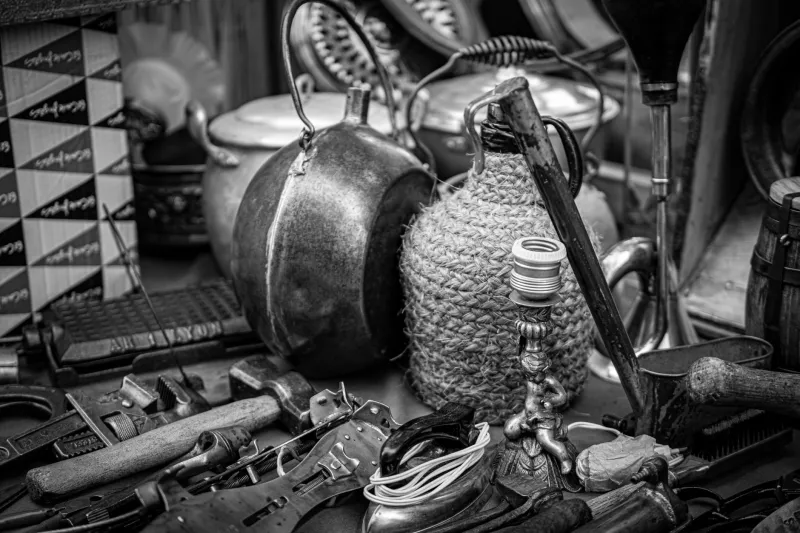
Every short film has a look. Some are lit like a Caravaggio. Yours, if the budget stretches to a round of teas and a tank of petrol, will be lit like a car boot sale at twenty to eight in the morning — which, handled with a bit of thought, is not the insult it sounds.
The trick is that a found-object aesthetic has to look chosen. There is a world of difference between a set that says 'we styled this from other people's cast-offs' and a set that says 'we ran out of time and this is what was in the boot of Dan's Fiesta'. One reads as a signature. The other reads as a cry for help. The gap between them is mostly discipline, a colour palette, and a phone full of continuity photos.
Start With a Palette, Not a Trolley Dash
The most common mistake is buying whatever looks charming. A wicker basket here, a brass squirrel there, a cushion with a phrase on it that seemed funny at the time. Three hours later you have forty objects that hate each other.
Before you go anywhere, decide on three colours and one texture. That's it. If your sketch is set in a slightly sad seaside B&B, maybe it's nicotine cream, faded green and rust, with a lot of bobbly wool. If it's a shared flat in Peckham, maybe it's white, black and a very specific 1970s orange, with wipe-clean plastic. Write it on your hand. Everything you pick up gets judged against it. Anything that fails goes back on the trestle table.
This is also the cheapest form of production design there is. A palette costs nothing and instantly makes a room look like somebody with taste made a decision.
The Two-Pound Rule
Set a hard ceiling per item — two pounds is a decent starting point, three if it's a hero prop. The cap does two things. First, it stops you spending forty quid on a chair that will be in focus for six seconds. Second, it forces you to buy things for how they read on camera rather than how much you like them in your hand.
And they will read smaller than you think. A mug is a dot. A vase is a smear. What registers on a phone screen at 6pm is silhouette, colour and texture, in that order. So favour objects with a strong shape and a bit of grubbiness over delicate little things with lovely detailing that no one will ever see.
The Sunday Morning Doctrine
Car boots reward the early and the polite. Get there before eight, bring cash in small notes, and remember that the person selling is usually having a nice morning and would rather chat than haggle hard over fifty pence. Ask what else is in the van. That question alone has furnished entire short films.
Buy job lots when you can — a box of mismatched crockery for three pounds is a dressing kit, not a purchase. Take a tote bag, take wet wipes, and take a friend whose job is to say 'no' to you.
Charity shops are the opposite discipline: slower, tidier, and ruthlessly sorted by someone with better taste than the car boot. That's a feature. Go on a weekday when the volunteers have time to talk, and mention you're dressing a film. In our experience they will often dig out the box in the back that hasn't made it to the shop floor yet, which is where the good grubby stuff lives.
Give Every Hero Prop an Understudy
If an object has to be touched, eaten, drunk, broken or dropped, buy two. Ideally three. A single charity-shop teapot in a comedy sketch about a disastrous tea party is not a prop, it is a hostage situation.
Label your spares. A strip of masking tape and a biro reading 'HERO — DO NOT DRINK FROM' has saved more shoots than any lighting diagram. Consumables are the sneaky ones: the level of squash in a glass, the number of biscuits left on a plate, the amount of ash in an ashtray. Either lock those down with photos or accept that your editor will be doing wizardry at midnight.
Photograph Everything, Then Photograph It Again
Continuity is where found-object dressing bites hardest, because nothing matches. Two similar mugs are never quite the same mug. So build the habit: a wide photo of the dressed set, then close-ups of every surface, then a photo of the floor, because someone will always move the rug.
Do it at the start of the day and again after lunch, when everybody has nudged things. Keep them in one album named after the scene. Future you, hunched over a timeline at eleven at night, will be genuinely emotional about this album.
The Boring Bit: Logos, Labels and Clearance
Now the grown-up paragraph. Charity shop finds arrive with history attached, and some of that history is other people's intellectual property.
Visible brand names, logos on packaging, recognisable magazine covers, band posters and artworks are all things a broadcaster or a client's legal team will ask about. The cheap fix is to dress around them: turn labels to the wall, choose plain packaging, design a fake cereal box in Canva, or hang a framed print of something you made yourself. Scuffed old hardbacks with the spines hidden are always safe and always look good.
Also think about people. Photographs of real, identifiable faces on a mantelpiece are a small but genuine risk, so swap them for pictures of your own nan (with permission) or a nice blurry landscape. And if a prop is electrical, assume it is not safe. Nothing kills a shoot's charm faster than a forty-year-old table lamp quietly attempting arson.
Shabby, Not Skimped
Here's the paradox worth holding on to: the found-object look only works when it's clear that somebody chose it. Jumble is accidental. Styling is deliberate. The difference is repetition — the same colour three times in a frame, the same era of crockery across two scenes, one motif that keeps turning up.
So don't clean everything. A little wear is the point. But do remove the charity shop price sticker, do iron the tablecloth, and do hide the modern carrier bag that wandered into the corner of the shot.
Dress a Corner, Not a Room
Finally, be realistic about coverage. You are probably shooting a two-metre-wide slice of a room, so put your money and your energy there and leave the rest as a rumour. A chair, a lamp, a stack of paperbacks and one good piece of wallpaper will do more than a fully furnished living room nobody ever sees.
Which is the whole appeal, really. A fiver at a car boot and an afternoon of discipline will buy you a look that reads as intentional — and at Sketchfilm, that's the sort of production value we'll always take over a bigger budget.